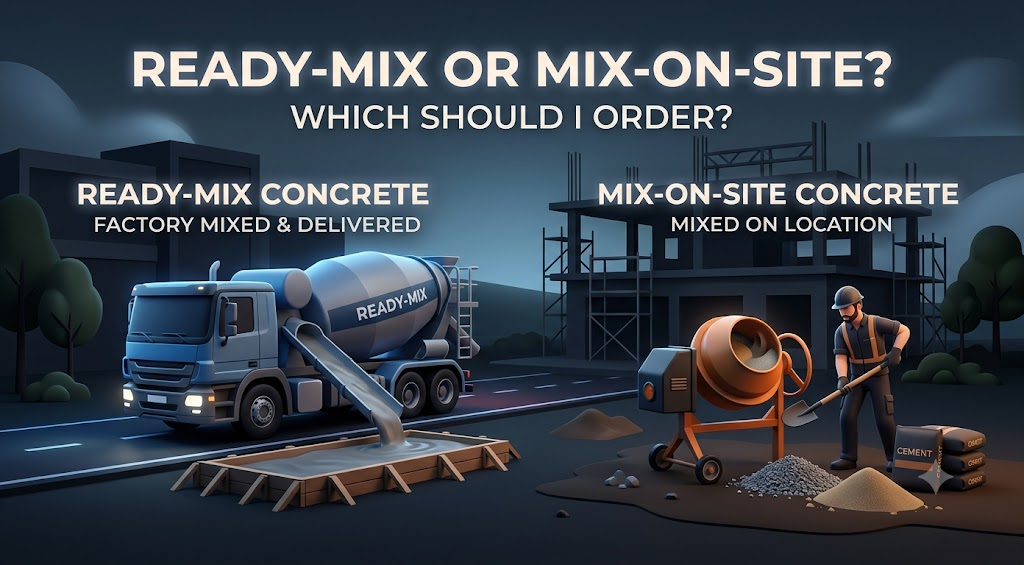
Every concrete project starts with the same question, and it is not always obvious which answer is right. Ready mix arrives ready to pour, mixed to a precise specification at a batching plant before it reaches your site. Mix-on-site concrete is combined on location, giving you more control over timing and batch size.
The right choice between the two depends on a handful of factors that the good concrete suppliers will ask you about before taking an order. Understanding both options makes that conversation much easier and helps you avoid costly mistakes before the work begins.
Ready-Mix vs. Mix-on-Site: What Is the Difference?
Both methods produce concrete, but the process that gets you there is quite different, and those differences matter depending on what you are building and where.
How Ready-Mix Concrete Is Prepared
Ready-mix concrete is batched at a central plant, loaded into a revolving drum truck, and delivered to site ready to pour:
- Mixed to a verified specification at a controlled batching facility
- The revolving drum keeps the mix workable throughout transit
- Consistent strength and composition guaranteed from batch to batch
- Comes with a delivery ticket confirming the mix design and admixtures used
How Mix-on-Site Concrete Is Prepared
Mix-on-site concrete, sometimes called volumetric concrete, is prepared using a mobile mixer that arrives carrying the dry materials separately and combines them on location according to the specified ratios. This allows the operator to adjust the batch size in real time and produce exactly as much concrete as needed, without committing to a fixed volume before the work begins.
That flexibility is its defining advantage. Because mixing happens at the site rather than at a plant, there is no delivery window to race against, jobs can be paused and resumed without wasting a load, and the mix can be adjusted between pours if conditions change.
Which Option Is Better for Your Project?
The short answer is that neither option is universally better. Each suits a different set of circumstances, and the project itself should guide the decision.
Best for Large Pours and Tight Timelines
Ready mix concrete is the standard choice for large volumes, time-sensitive pours, and anything where structural integrity must be verified before sign-off. Foundation slabs, suspended floors, columns, and large driveway projects all fall into this category.
When speed and strength are the priority:
- Ready mix delivers a consistent, tested specification with every load
- Large volumes can be ordered in multiple trucks on a scheduled basis
- The mix design is agreed in advance and does not change between deliveries
- No on-site mixing equipment or additional labour is needed
Best for Small Jobs or Difficult to Reach Sites
Mix on-site concrete is better suited to smaller repairs, narrow access routes, or projects where the exact volume is difficult to predict. Because the truck carries dry materials rather than wet concrete, it can wait on site without any waste, making it ideal for jobs that are likely to take longer than a standard ready mix delivery window allows.
Cost, Quality, and Speed Comparison
Here are the three factors most buyers weigh when choosing between the two options.
Upfront Cost and Labour Needs
- Ready mix typically carries a higher minimum order, making it less economical for very small volumes.
- Mix on site avoids minimum load charges and bills only for what is poured, which reduces waste on smaller jobs.
- Ready mix requires enough hands on site to place and finish quickly, since working time is limited once the truck arrives.
- Mix on site is more forgiving of smaller crews, as the supply rate can be matched to the finishing pace.
Consistency, Waste, and Quality Control
Ready mix is produced to a verified specification and comes with a delivery ticket confirming the mix design, water-to-cement ratio, and admixtures used, which is documentation that structural and commercial projects frequently require. The trade-off is that unused concrete in a partial load goes to waste and the mix cannot be adjusted once the truck has left the plant.
Mix on site avoids both of those constraints, since only the concrete needed is produced and adjustments can be made between batches. Quality control shifts accordingly, depending more on the skill of the operator and the calibration of the machine than on factory conditions, which is worth confirming with the supplier before committing this method to a critical pour.
Delivery Speed and Site Flexibility
Ready mix has a shorter lead time from order to delivery, particularly for standard mixes, and can be arranged quickly for urgent pours. Mix-on-site vehicles are larger and need adequate access, but once on site they offer far more flexibility in terms of how long the concrete supply can be sustained.
When to Order Ready-Mix
Ready mix is the preferred method for larger, more demanding projects where specification and traceability matter. These two situations cover the most common scenarios where it is clearly the right choice.
Structural Work and Bigger Volumes
- Foundation and ground-bearing slabs where a specified grade must be confirmed.
- Suspended floors, columns, retaining walls, and reinforced groundworks
- Driveway and hardstanding pours above a few cubic metres
- Any project where multiple loads need to arrive on a scheduled basis
For all of these, the consistency and traceability of a batching plant outweigh the added flexibility of volumetric mixing.
Projects Needing Reliable Uniform Strength
When the project specifies a particular concrete grade, such as C25, C30, or C35, ready mix is the most straightforward way to guarantee that grade across the entire pour. Reputable concrete suppliers produce their mixes to British Standards and can provide test data to support the specification, which is important for any work subject to building regulations or engineer sign-off.
When to Order Mix-on-Site
Mix on site concrete suits projects where flexibility, access, or unpredictable volume make a load batched at a central plant impractical. These are the two situations where it tends to outperform ready mix.
Small Repairs and Custom Batches
- Patching and repair work where the exact volume is difficult to predict in advance
- Garden walls, paths, steps, and landscaping projects with modest volumes
- Small extensions and outbuildings where multiple mix designs may be needed in one day
- Any job where work is likely to pause and restart rather than run as a single continuous pour
Remote or Access Limited Locations
For sites where a large transit mixer cannot safely or practically reach, a volumetric truck often offers a workable alternative. These vehicles are designed with flexibility in mind, though they still require reasonable access, so it is worth confirming clearance widths and turning space with the supplier before booking.
Final Ordering Tips
Getting the right concrete comes down to preparation rather than guesswork. Before calling the concrete suppliers, run through these three checks to avoid problems on pour day:
- Calculate your volume first and add a five to ten per cent contingency allowance. For time-pressured pours, ready mix is the safer choice. For smaller or flexible jobs where the volume is harder to predict, mix on site tends to offer better value.
- Confirm access for the delivery vehicle by checking road widths, gate clearances, and any overhead obstructions. Ready mix has a tighter working window once it arrives, so your team, tools, and shuttering should all be in place before the truck turns up.
- Match the mix to the specification, not to the price alone. Choosing the cheapest option without considering the grade is a false economy on structural work, where the wrong mix can cost far more to remedy than the saving was worth. Reliable suppliers advise on the correct grade and admixtures before the order is placed.
Bottom Line
Both ready mix and mix-on-site concrete have their place, and the right choice depends on the size, specification, and conditions of the job rather than habit or price alone. Understanding the difference before you order makes the conversation with your supplier more productive and reduces the risk of delays or rework once the work is underway.
Pro-Mix Concrete supplies ready mix and volumetric concrete across London and the surrounding area, with experienced teams who can advise on the right mix for your project from the first call. Every order is backed by full specification support, delivery scheduling, and documentation for structural and regulated work. Whether it is a driveway pour or a large commercial slab, the team at Pro-Mix Concrete matches the product to the job rather than the other way around.
Get in touch with them to discuss your requirements and arrange delivery.
Read More: When Should You Use Boom Pump Hire Instead of a Line Pump